10% off your first original artwork — Get your private offer
About
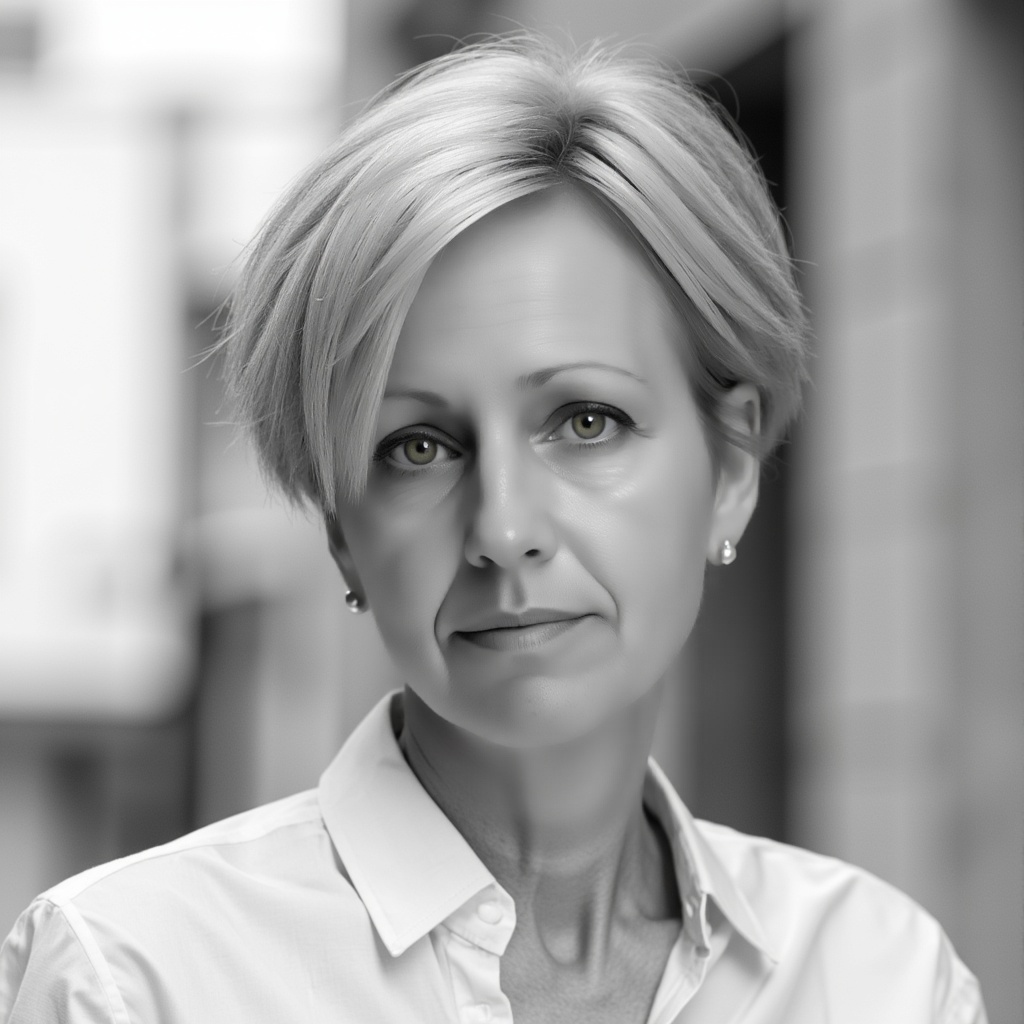
Hello, I’m Veronika
I’m a contemporary artist originally from Russia, and Spain has been my home since 2010. I now live and work on the Mediterranean coast near Barcelona.
How I work
Before focusing on painting, I experimented with different creative practices, including jewelry making. I think something from that experience has stayed with me: precision is still an essential part of how I work. What may look like a simple line in one of my paintings is usually the result of a long process. When developing a new composition, I can spend hours adjusting angles, distances and proportions — sometimes down to millimeters — until everything feels exactly right.
Over the past few years, my work has been exhibited across Europe and the United States and has entered museum and private collections.
About my professional practice
Below you can find my professional biography, artist statement, and the principles that shape my work.
Professional BIO
Veronika Obushikhina (b. 1976, Russia) is a contemporary artist based in Barcelona, Spain.
Working across painting and video, Obushikhina develops a practice centered on the exploration of a reduced visual language. Her work is built around a limited set of elements—form, colour, line and space—and investigates how expressive an image can become through the deliberate reduction of visual means.
Rather than beginning with predefined narratives or symbolic meanings, her artistic process is driven by visual inquiry. She explores the different forms a line can take, the way colour shapes the perception of form, and how space can be created through only a few precisely balanced elements. In her work, minimalism serves as a means of directing attention to what is essential and revealing the independent expressive potential of form.
Obushikhina’s work has been exhibited internationally in Europe and the United States, including presentations at MEAM – Museu Europeu d’Art Modern, Barcelona, as well as exhibitions in Barcelona, Málaga and Berlin. In 2026, her work was selected for the Biennale di Chianciano, Italy, and she was named a finalist of the OSTEN Biennial in Skopje, North Macedonia. She has also been selected to participate in Rome Triennale 2027.
Her work is held in the permanent collection of the Chianciano Art Museum, Italy, as well as in private collections throughout Europe and the United States.
Obushikhina completed her studies at the Institute of Mediterranean Culture in 2025. She continues to develop a multidisciplinary practice situated at the intersection of perception, spatial inquiry and contemporary minimalism
Internationally collected. Emotionally resonant
Artist Statement
I work with simplicity pushed to its limit. Through the reduction of visual language, I explore the expressive possibilities of form.
My work does not begin with a narrative, symbolic meaning, or a predefined concept. Instead, it is driven by visual inquiry. Each new work begins with a question: what other possibilities can emerge within a deliberately limited visual language?
Line, form, colour and space become independent elements of that language. I am interested not in what they represent, but in how they exist, interact with one another, and communicate through their relationships.
By reducing each composition to its essential elements, I seek to eliminate everything that distracts from form itself. In my practice, minimalism is neither a stylistic choice nor an end in itself. It is a method of investigation that allows me to focus on the precision of every element and its role in shaping a coherent visual image.
Each work becomes a continuation of this process of inquiry. Through the exploration of new forms, colour relationships and spatial structures, I gradually expand the possibilities of my own visual language.
My works do not propose a single interpretation. Instead, they create a space for perception, where meaning emerges not from the artist’s explanation, but through the viewer’s direct encounter with form.
Structural Minimalism
Structural Minimalism is the artistic concept that underlies my practice. It explores how a deliberately reduced visual language can generate a rich artistic experience. Rather than assigning predetermined symbolic meaning to form, Structural Minimalism approaches form as the subject of independent visual exploration.
Five principles of Structural Minimalism
1. Limitation as Method
Every work begins with the conscious limitation of visual means. The fewer elements present within a composition, the more significant the role of each becomes.
2. Form as Exploration
Form does not illustrate a preconceived idea. It emerges through the process of making. Each new work investigates another possibility of line, colour, space, or the relationships between them.
3. The Question Before the Answer
Every work begins not with a statement, but with a question. The artistic process becomes a search for a new visual solution, while the finished work represents only one possible answer—one that naturally leads to the next question.
4. Simplicity as Concentration
Simplicity is neither an end in itself nor merely a stylistic choice. It is a way of concentrating attention on what is essential. By removing everything unnecessary, the artist allows form, colour, line, and space to reveal their own expressive qualities.
5. Freedom Within Limits
A limited visual language is not a restriction but a source of freedom. Working within self-imposed boundaries opens an endless field for exploring new forms and relationships between visual elements.